AEGIS has co-developed and supplied firefighting solutions for Samsung SDI's Energy Storage Systems since 2019, optimised specifically for cell-unit fires — the failure mode existing fire extinguishing systems cannot reach once thermal runaway begins inside a sealed module.
In controlled testing at Samsung SDI's Ulsan factory, modules equipped with AEGIS's special fire suppression system contained cell-level ignition: impacted-cell temperature rose then cooled rapidly, with unimpacted cells in the same module staying near ambient. A module without the suppression system, tested under the same impact, saw fire and smoke spread across the entire module within minutes.
Discuss an ESS Deployment
Joint development and supply of firefighting solutions for battery cell modules since 2019 — sheet, wire, panel and film formats matched to module geometry.
EV charger and safety equipment integration, protecting charging points against thermal runaway ignition during charge cycles.
Logistics robot safety equipment — protecting onboard battery packs and control electronics in continuously operating fleets.
ESS systems for defence-use applications, where unattended, always-ready suppression matters most.
Expansion into consumer products — starting with multi-plugs and extension sockets carrying AEGIS PAD protection at the outlet itself.
Panel rooms, switchgear and server rooms across industrial facilities, commercial buildings and communications infrastructure.
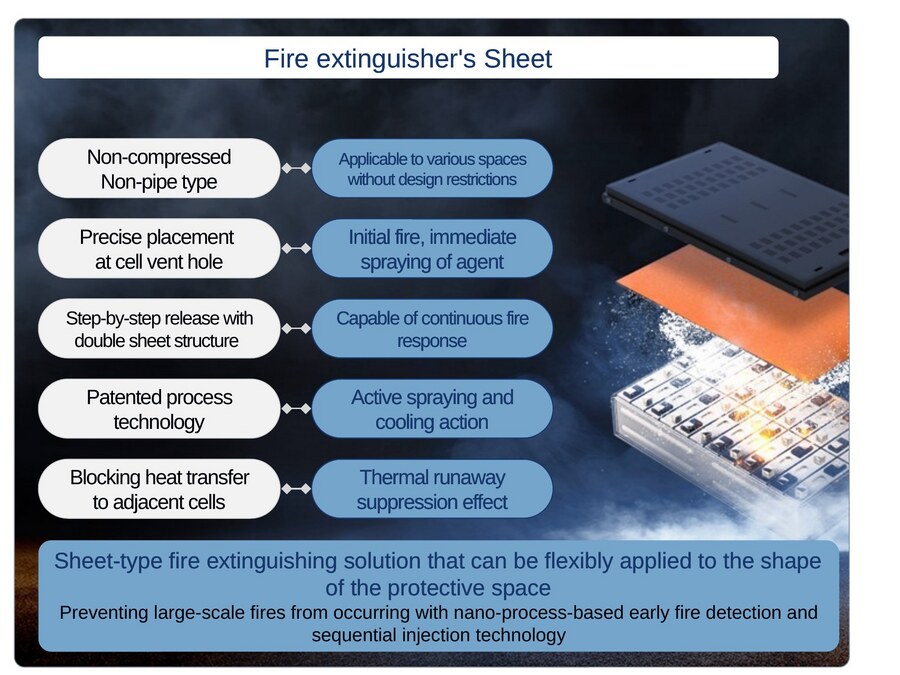
AEGIS sheets are placed with precision at the cell vent hole — the exact point where thermal runaway first vents — with a double-sheet structure enabling step-by-step, continuous fire response rather than a single-use burst.
Applicable to various spaces without design restrictions.
Immediate spraying of agent right at the cell vent hole.
Double sheet structure capable of continuous fire response.
Thermal runaway suppression effect between adjacent cells.
We break down five recent SEA fire case studies and where an active suppression layer would have changed the outcome.